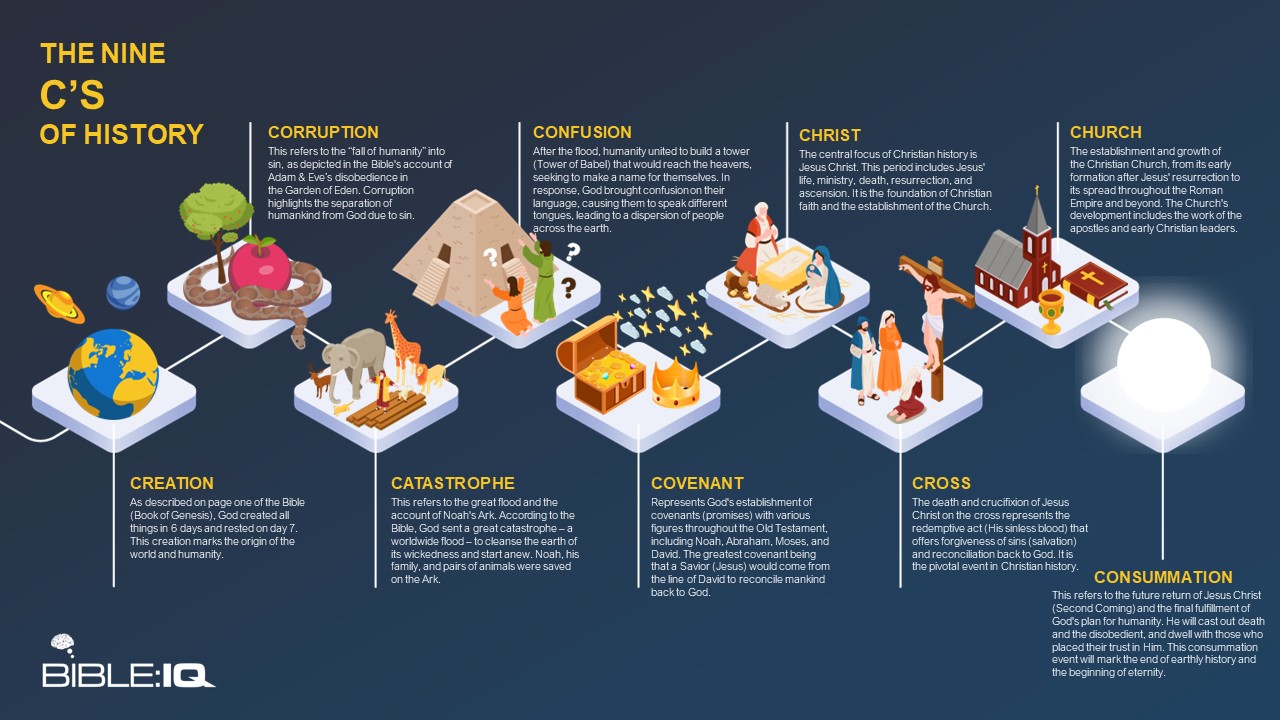
The "9 C’s of History" is a framework that outlines significant events and periods in the history of Christianity as described in the Bible. The 9 C's are often used as a helpful mnemonic for remembering the key stages of Christian history. Here they are: 1. Creation: As described on page one of the Bible (in the Book of Genesis), God created all things in 6 days and rested on day 7. This creation marks the origin of the world and humanity. 2. Corruption: This refers to the “fall of humanity” into sin, as depicted in the Bible's account of Adam and Eve's disobedience in the Garden of Eden. Corruption highlights the separation of humankind from God due to sin. 3. Catastrophe: This refers to the great flood and the account of Noah's Ark. According to the Bible, God sent a great catastrophe – a worldwide flood – to cleanse the earth of its wickedness and start anew. Noah, his family, and pairs of animals were saved on the Ark. 4. Confusion: After the flood, humanity united to build a tower (Tower of Babel) that would reach the heavens, seeking to make a name for themselves. In response, God brought confusion on their language, causing them to speak different tongues, leading to a dispersion of people across the earth. 5. Covenant: Represents God's establishment of covenants (promises) with various figures throughout the Old Testament, including Noah, Abraham, Moses, and David. These covenants play a crucial role in shaping God's relationship with humanity. The greatest covenant being that a Savior (Jesus) would come from the line of David to reconcile mankind back to God. 6. Christ: The central focus of Christian history is Jesus Christ. This period includes Jesus' life, ministry, death, resurrection, and ascension. It is the foundation of Christian faith and the establishment of the Church. 7. Cross: The death and crucifixion of Jesus Christ on the cross represents the redemptive act (His sinless blood) that offers forgiveness of sins (salvation) and reconciliation back to God. It is the pivotal event in Christian history. 8. Church: The establishment and growth of the Christian Church, from its early formation after Jesus' resurrection to its spread throughout the Roman Empire and beyond. The Church's development includes the work of the apostles and early Christian leaders. 9. Consummation: This refers to the future return of Jesus Christ (Second Coming) and the final fulfillment of God's plan for humanity. He will cast out death and the disobedient, and dwell with those who placed their trust in Him. This consummation event will mark the end of earthly history and the beginning of eternity. The "9 C's of History" provides a concise overview of the major themes and milestones in Christian history, belief and theology. They serve as a helpful tool for understanding and remembering the foundational elements of the Christian faith and its historical development.